
How to Read a UK Hallmark: A Beginner’s Guide
Found a tiny collection of letters, numbers and symbols on your jewellery and wondered what they mean?
You’re not alone. UK hallmarks can look confusing at first, but once you know what to look for, they tell you fascinating information about a piece of jewellery, including what precious metal it contains, where it was tested and, in some cases, when it was hallmarked.
In this simple guide, we’ll break down how to read a UK hallmark, step by step.
What is a UK hallmark?
A UK hallmark is a series of marks applied to an item made from precious metal. It provides information about the metal and confirms that it has been independently tested and hallmarked by an official Assay Office.
A typical UK hallmark is made up of three compulsory marks:
- The Sponsor’s Mark
- The Fineness Mark
- The Assay Office Mark
You may also see additional marks, such as a Date Letter, a traditional fineness symbol or a Convention Mark.
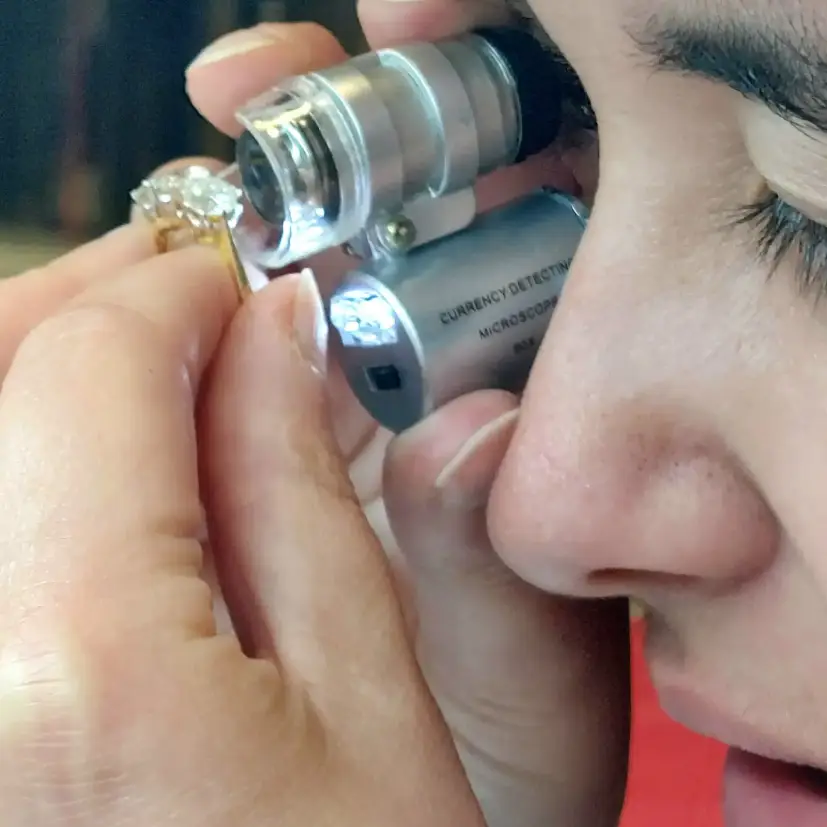
Hallmarks can be extremely small, particularly on rings and delicate jewellery. The smallest hallmark we apply at Birmingham Assay Office is just 0.25mm! A good light and a magnifying glass can make them much easier to see.
Step 1: Find the Fineness Mark
The easiest place to start when learning how to read a UK hallmark is usually the number.
The fineness mark tells you the proportion of precious metal in the item, expressed in parts per thousand. This is called millesimal fineness.
For example:
Fineness mark | What it means |
375 | 37.5% pure gold – commonly called 9ct gold |
585 | 58.5% pure gold – commonly called 14ct gold |
750 | 75% pure gold – commonly called 18ct gold |
916 | 91.6% pure gold – commonly called 22ct gold |
925 | 92.5% silver – sterling silver |
950 | 95% platinum or palladium, depending on the item and hallmark |
The number is not a percentage, but parts per thousand. So a 925 silver hallmark means that 925 parts out of 1,000 are silver.
Different precious metals have different recognised fineness standards.
Step 2: Look for the Assay Office Mark
Next, look for the Assay Office Mark.
This tells you which Assay Office tested and hallmarked the item. There are four UK Assay Offices, each with its own distinctive mark.
If you see an anchor, your item was hallmarked by Birmingham Assay Office.
Other UK Assay Office marks represent London, Sheffield and Edinburgh.
It’s worth remembering that the Assay Office mark tells you where the item was tested and hallmarked – not necessarily where it was made.
Step 3: Find the Sponsor’s Mark
The Sponsor’s Mark is usually made up of two or more letters inside a distinctive shape.
It identifies the company, individual or business responsible for submitting the item for hallmarking. You may also hear this referred to as a Maker’s Mark, although “Sponsor’s Mark” is the modern term.
The Sponsor’s Mark can be particularly useful if you are researching the history of an older piece of jewellery.
However, it does not necessarily mean that the person or company represented by the mark physically made the jewellery. A sponsor can be a manufacturer, dealer, importer or even simply an owner.
Step 4: Look for a Date Letter
Some UK hallmarks include a Date Letter.
A Date Letter is a small letter that indicates the year in which an item was hallmarked. The appearance of the letter, including its font, case and surrounding shape, is important when identifying the year.
Date letters have changed over the years, and historically each UK Assay Office had its own date-letter cycles. From 1975, the UK Assay Offices adopted a standardised system. The date letter is now an optional mark rather than a compulsory part of a hallmark.
Want to find out the year your jewellery was hallmarked?
Birmingham Assay Office has an archive of Birmingham date letters dating back to the Assay Office’s foundation in 1773.
You can purchase lifetime access to the Birmingham Assay Office Date Letter Archive for £2 and search the archive by year or letter.
Step 5: Identify Any Remaining Marks
You may still have one or more additional marks left to inspect. These can include traditional fineness symbols, which were used in the past to indicate the precious metal standard instead of the millesimal fineness numbers used today. For example, you may find a crown for gold or a lion passant for sterling silver on older pieces. Traditional fineness symbols can still be applied alongside the compulsory hallmark marks today.
You may also see a Convention Mark, which indicates that an item has been hallmarked under the international Hallmarking Convention and can be sold as a precious metal article in other member countries with the need for re-marking.
These additional marks can be particularly helpful when researching the age, origin or history of a piece.
What do the marks look like together?
A modern UK hallmark might contain something like:
Sponsor’s Mark → Fineness Mark → Assay Office Mark
For example, if you have a gold ring with a 750 fineness mark and a Birmingham anchor, you can identify it as 18ct gold that was tested and hallmarked at Birmingham Assay Office.
Remember that the exact order, appearance and number of marks can vary depending on the age and type of item.
Does every piece of precious metal jewellery have to be hallmarked?
UK hallmarking requirements depend on the type and weight of the item.
Currently, the minimum weights above which hallmarking is required are:
There are also specific rules and exemptions as outlined in the Guidance Notes issued by the four UK Assay Offices alongside the British Hallmarking Council.
So, if a small piece of jewellery does not have a hallmark, that does not automatically mean something is wrong. Its weight, age and circumstances can all be relevant.
Can a hallmark tell me when my jewellery was made?
Not necessarily.
A Date Letter tells you the year the item was hallmarked, rather than necessarily the year it was designed or made.
For example, an older piece of jewellery could potentially be repaired or remodelled and then hallmarked again. It is therefore best to think of the Date Letter as telling you when the particular hallmark was applied.
For historical jewellery, the hallmark is one useful piece of evidence alongside the design, construction, provenance and any other marks or documentation.
Can I identify the maker from a hallmark?
Sometimes.
The Sponsor’s Mark can help you identify the person or business that registered the mark and submitted the item for hallmarking. However, identifying an individual mark can require specialist research, particularly with older jewellery.
A hallmark can therefore provide a useful starting point when researching the history of a piece, but it may not tell you everything about its origins.
Want to find out when your jewellery was hallmarked?
Explore the Birmingham Assay Office Date Letter Archive and search thousands of historic Birmingham date letters.
Purchase access to the Birmingham Assay Office Date Letter Archive →
Have a treasured piece you’d like to know the value of? Get in touch and find out in just 10 working days.
Other Posts

How to Read a UK Hallmark: A Beginner’s Guide
Found a tiny collection of letters, numbers and symbols on your jewellery and wondered what they mean? In this simple guide, we’ll break down how to read a UK hallmark, step by step.

Birmingham Heritage Week 2026
We’re looking forward to opening the doors of Birmingham Assay Office to the public again as part of Birmingham Heritage Week 2026. The city-wide initiative has grown year on year and we enjoyed two sell-out tours of the hallmarking floor in 2025.

A Medal for a Legend: Ozzy Osbourne
Fans, friends, and family came together last week at Merlin’s Bar to remember Ozzy Osbourne on the 21st July, the eve of the first ever official Ozzy Day. We were given a moment with Sharon so that Sally Costen could present her with the medal she designed in Ozzy’s honour.
Understanding Your Jewellery Valuations
Inherited a family heirloom, purchased a new engagement ring, or have built your own a collection of fine jewellery? Knowing its true value is more important than many people realise.
Have Your Say: British Hallmarking Council Launches Industry-Wide Survey
The BHC wants to hear from people and businesses in the UK who use, are required to use, or may be affected by hallmarking, on the practical application of the Hallmarking Act (1973),